
ATHX PI100: A Fitness Score That Puts Your Results in Context
What does your ATHX result mean in context? Discover PI100, an independent 0–100 scoring system developed from 11,063 recorded performances across strength, endurance and MetCon X.

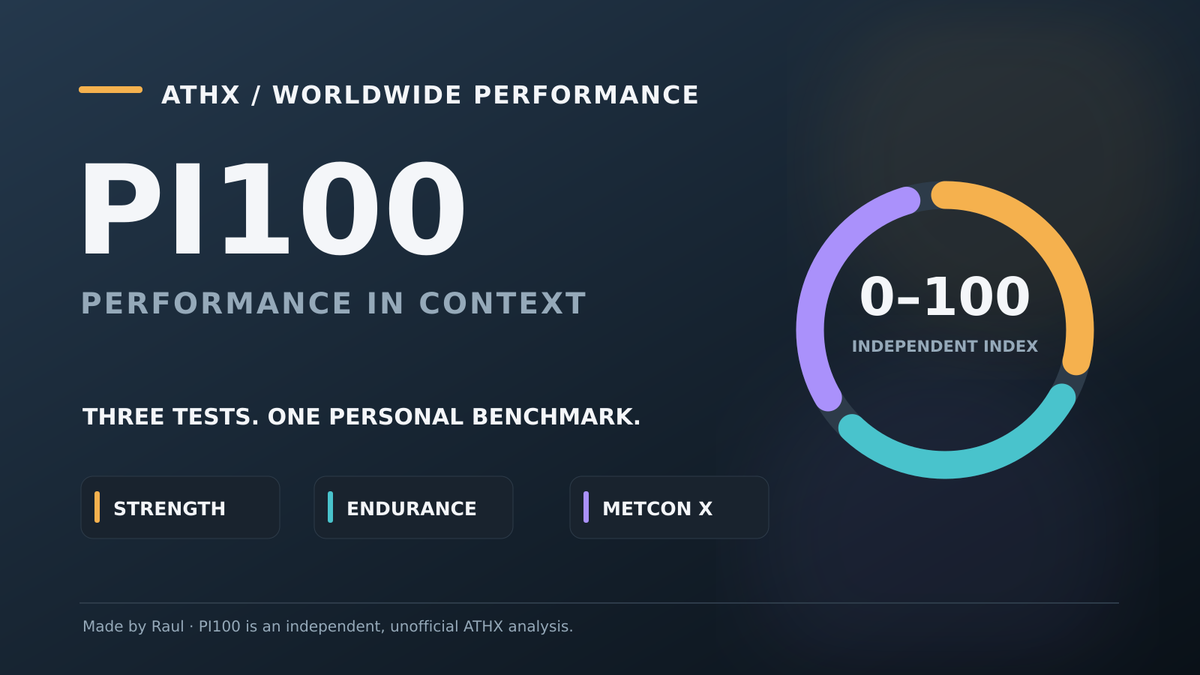
An ATHX workout gives you three results: a strength total, an endurance distance, and a MetCon X finish time. But what do those numbers mean in context?
After analyzing 11,063 recorded performances from the official ATHX Games 2026 leaderboards, I developed PI100—an independent scoring model that turns each result into a number between 0 and 100.
The idea is simple: give athletes a clearer picture of their performance across strength, endurance, and functional conditioning, without making it a competition against someone else's best day.
PI100 can show two useful perspectives: a score based on your age group, and one based on all ages in your division. Same performance, different reference points.
My Own ATHX Results: A Real Example
What My Scores Reveal
What I find particularly interesting is how closely these scores reflect my own experience and how I felt during the event.
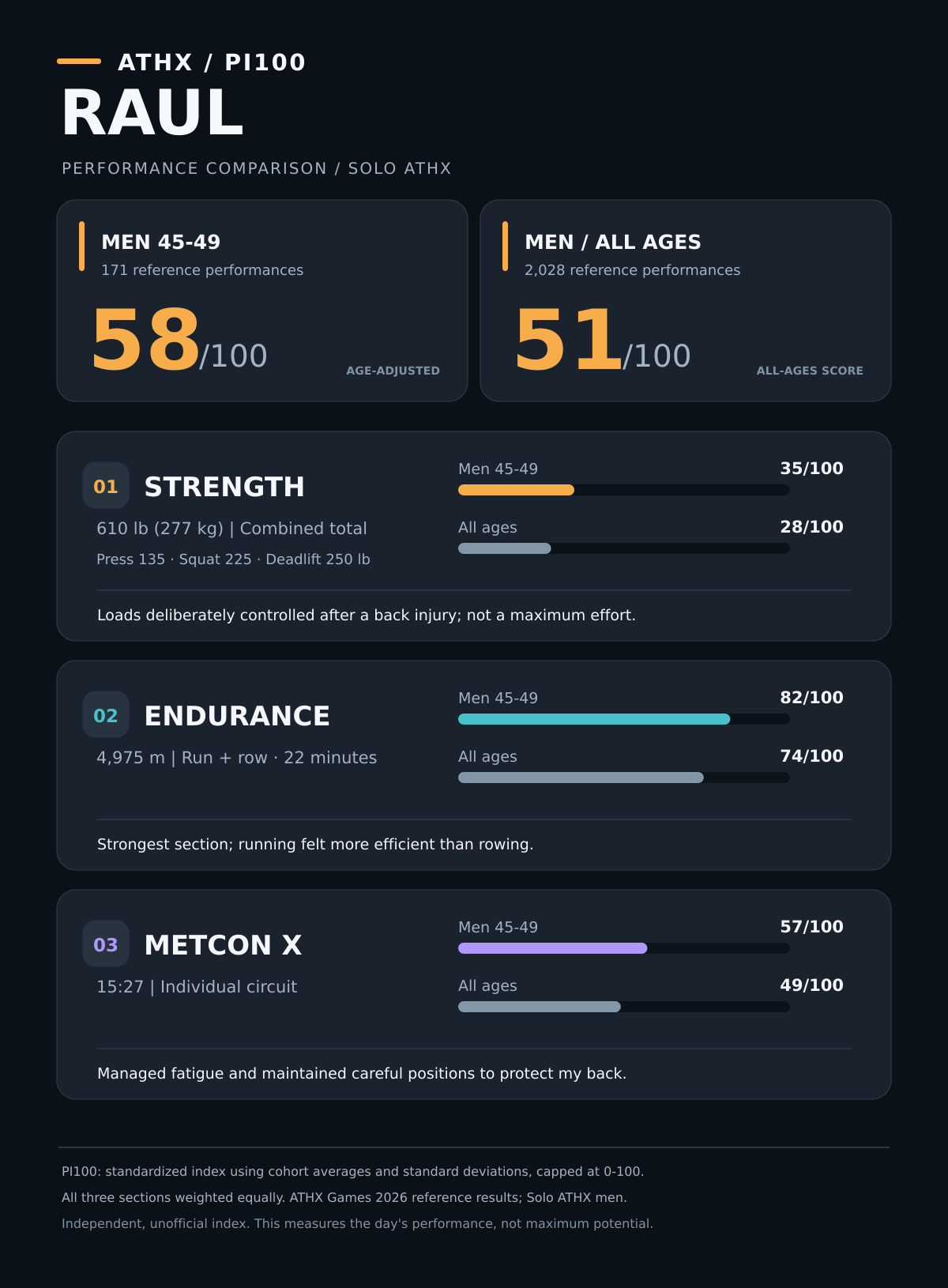
Strength — 35/100 (age group) | 28/100 (all ages)
I was recovering from a recent back injury, so I deliberately kept my weights conservative. My priority was maintaining proper technique rather than testing my maximum strength.
The score reflects what I lifted that day, not necessarily my full strength potential.
Endurance — 82/100 (age group) | 74/100 (all ages)
This was clearly my strongest section.
Coming out of marathon training, I felt comfortable during the 22-minute effort and managed to cover 4,975 metres. Running felt more natural and efficient than rowing.
MetCon X — 57/100 (age group) | 49/100 (all ages)
By the final section, fatigue was starting to accumulate.
I managed my pace and focused on maintaining good positions, especially during movements that placed additional demands on my back.
I finished in 15:27 without pushing to my absolute limit.
The takeaway?
The PI100 scores align surprisingly well with my intuition and how I experienced each part of the event.
More importantly, they help identify my strengths and areas where I could improve.
What Does a PI100 Score Actually Mean?
PI100 measures your performance relative to a specific group of ATHX participants.
The scoring system follows a few simple principles:
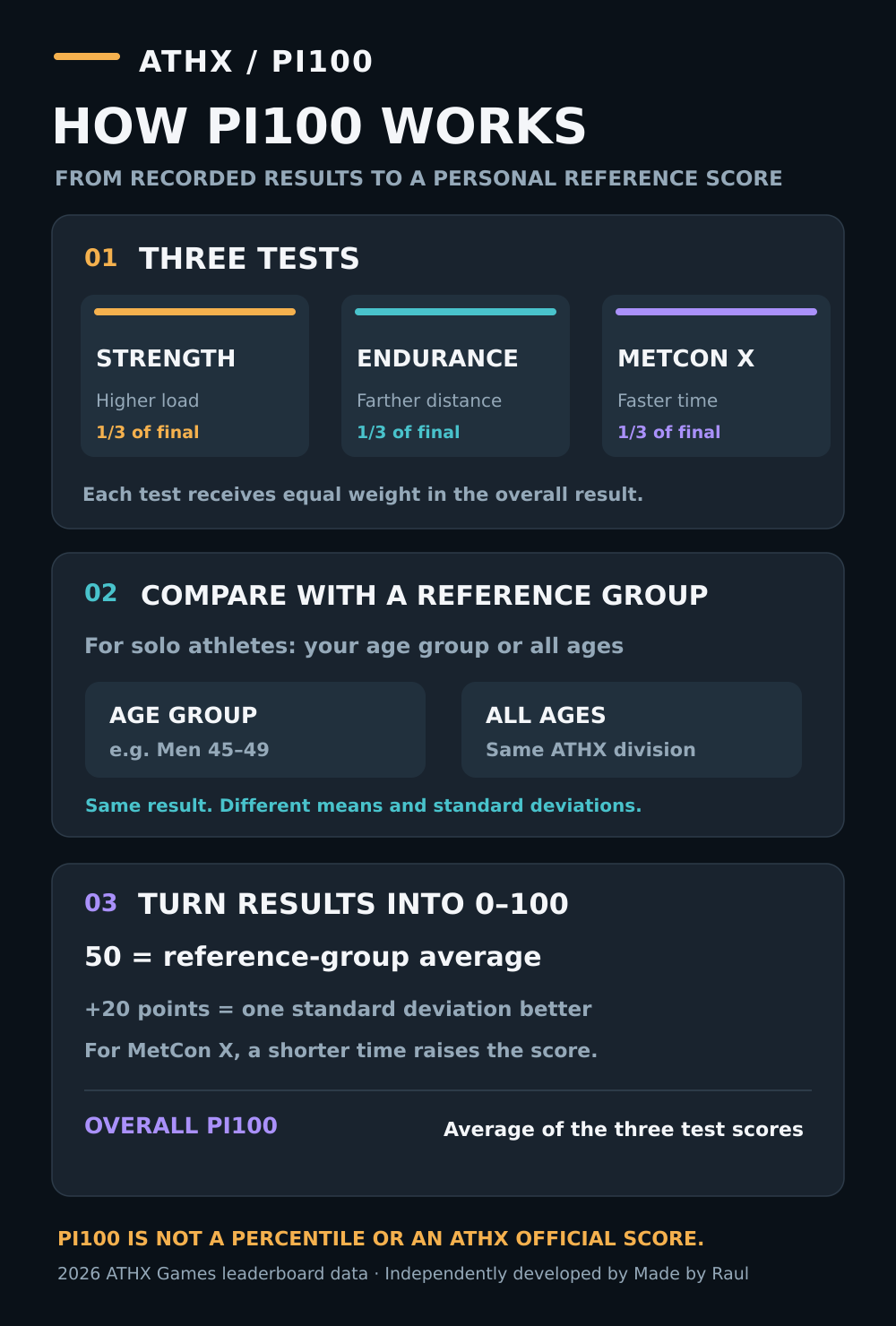
- 50 points represents the average performance of the reference group.
- 70 points represents a result one standard deviation better than the average.
- 90 points represents a result two standard deviations better than the average.
- Scores are limited to a range of 0 to 100.
For Strength and Endurance, higher results produce higher scores. For MetCon X, a faster finishing time produces a higher score.
Each of the three sections contributes equally to your overall PI100 score.
Two Ways to Evaluate Your Performance
For individual athletes, PI100 can provide two perspectives:
1. Age-group score
Compares your performance with athletes in your age group and division.
2. All-ages score
Compares your performance with athletes of all ages in the same division.
Both perspectives are useful, but they answer different questions.
One important distinction: PI100 is not a percentile. A score of 82/100 doesn't mean you performed better than 82% of participants.
It's a standardized performance index designed to help you better understand your results.
Sources and Methodology
Data Sources
The PI100 model was developed using publicly available results from the official ATHX Games leaderboards:
The dataset includes 11,063 recorded performances across 13 individual and pairs divisions from ATHX competitions worldwide in 2026.
Data snapshot: October 26, 2026.
These are recorded performances, not necessarily unique athletes. Participants who competed in multiple events may appear more than once.
Scoring Methodology
For each reference group, the model calculates the average performance and standard deviation for:
- Strength — total weight lifted (kg)
- Endurance — total distance covered (m)
- MetCon X — finishing time (mm)
Each performance is converted into a score between 0 and 100 based on its distance from the group's average.
The overall PI100 score is calculated by averaging the three section scores, with equal weighting.
For individual competitors, reference groups can be defined by division, gender and age group.
Limitations
Some results may be excluded when values are missing or clearly implausible.
Smaller reference groups can produce less stable scores, so comparisons based on limited data should be interpreted cautiously.
The model measures performance relative to recorded ATHX results. It does not measure an athlete's absolute fitness, health or maximum potential.
Independent Analysis
The performance data comes from ATHX Games, but the PI100 methodology, calculations and visualizations were independently developed by Made by Raul.
PI100 is an experimental scoring system and is not affiliated with, endorsed by, or an official scoring system of ATHX Games.